






Buy Direct
Best when the exact equipment package is already understood and you need a faster route to purchase.
ATA fly racks, shock-mount racks, Pelican and SKB shells with rails, and tall control racks. Pick the RU, then the build.
Rack units the case is built around.
How the rack is carried.
Lids and wheels.
| Build | When it is the right case |
|---|---|
| ATA fly rack | Touring 2U–8U that stacks, front + rear lids, dressed cables stay in the case. |
| Shock-mount rack | Sensitive electronics that cannot take truck-floor shock. |
| Pelican / SKB shell with rails | Weather, wheels + tow handle, 2U / 4U / 6U drop-in. |
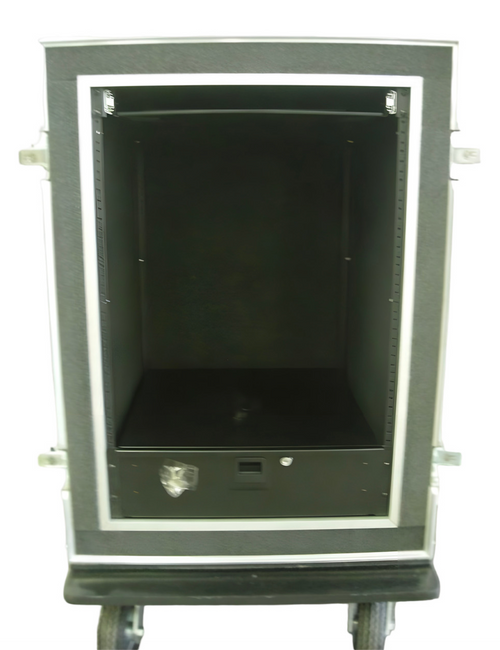
| Control / workstation rack | Tall RU counts, sliding work surface, casterboard, 1,000 lb class. |
Different RU, deeper rail, keyboard drawer, or a second rack in the same shell → request a spec.
Custom protective cases for rack-mounted gear. 2RU through 28RU: ATA fly racks that stack, shock-mounted and floating-rack interiors, tall control racks, and rack frames built to drop into a Pelican or SKB shell.
Pick the RU count, then the build. Every rack is built to order in North Hollywood, CA; a different RU, a deeper rail-to-rail or a matching stack is a quote item.
Start with the RU count your stack actually occupies, then add one RU of dressing space if cables exit the rear of any unit. Filter by RU above, then by build. Every rack here is a standard 19″ frame threaded for 10-32 screws unless the title says otherwise.
Rack width is fixed; depth is not. Measure the deepest unit from the front of its rack ears to the back of its rear connectors, add the cable bend, and compare that to the rail-to-rail figure in the case specs. 14″ suits DAs, patch panels and small switches; 20″ covers most broadcast routers and audio interfaces; 24″–36″ is server, amplifier and control-console territory. If a listed depth is short for your gear, the build is a quote, not a compromise.
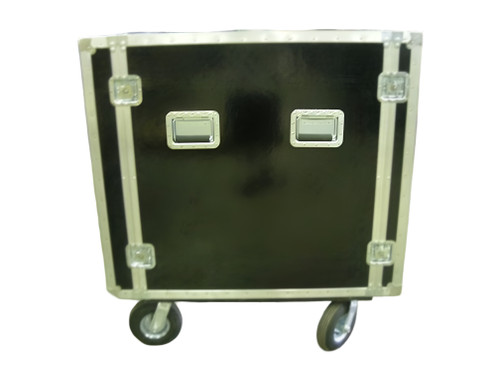
ATA fly rack — a rigid rack frame fixed inside the ATA shell, front and rear lids that lift off so the rack is cabled in the case. Lightest, stacks with matched RU siblings, right for gear that can take normal truck handling.
Shock-mount rack — the rack frame floats on rubber isolators inside the shell, so impact and truck-floor vibration reach the shell and not the equipment. Choose it for servers, mixers, RF and anything with spinning drives or delicate connectors.
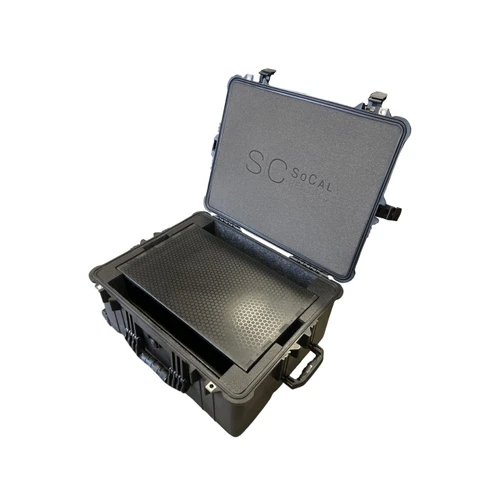
Pelican or SKB shell with rails — a 2U–6U rack frame set into a molded, gasketed shell with wheels and a tow handle. Weather, airline checking, and a one-person move are the reasons to pick it.
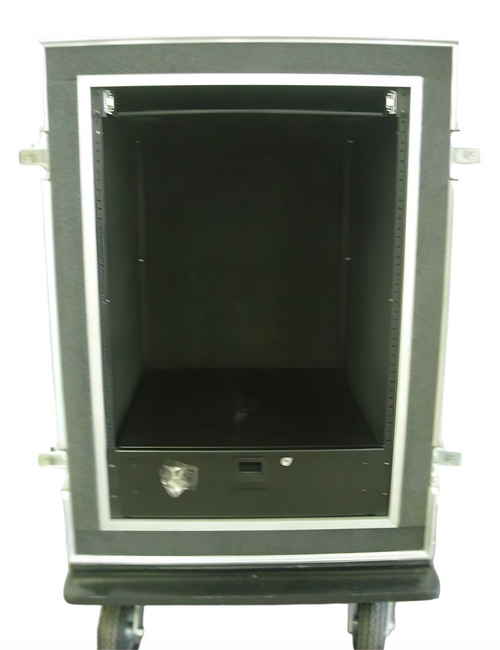
Control or workstation rack — tall RU counts, a lid that becomes a work surface, side access panels and a casterboard rated for the full load. Built for consoles and control positions that roll in and are working in minutes.
Front-only lids suit desktop and cart deployment; front + rear lids are the norm for anything that gets serviced in the case. Casters matter above roughly 80 lb loaded — check the caster rating in the specs against your racked weight, not the empty case. Most racks here ship with recessed handles, recessed latches and steel ball corners; padlock-ready latches are available on request.
Racks are built to order in North Hollywood, CA, typically 14–21 business days from confirmation. Drawings are retained against the build, so a matching 2U + 4U + 6U stack, a re-order for a rental fleet, or engraving can be added against the same layout. Fixed shipping applies where a product page says so; large racks ship freight.
Not seeing your RU count, depth or a shock-mounted version of a case above? Request a spec and include the gear list with RU per unit.
Start with the product type if your fit is already known. Use filters when you are narrowing by shell, size, or use case. If the build is unusual, overloaded, or timing-sensitive, move into the custom path before forcing a guess.
Best when the exact equipment package is already understood and you need a faster route to purchase.
Narrow the grid by product type and compare options before committing to a shell or interior direction.
Start a custom project when the kit, accessories, or shipping demands fall outside a standard fit.